
Performance · Cognitive Health
If you run on coffee to think but still hit a wall by 2 p.m., the problem isn't you, and it isn't the caffeine. It's how coffee delivers it. Here's the five-minute version, and the swap thousands of knowledge workers are quietly making.
It's 9:00 a.m., you've had your coffee, and instead of clarity you feel twitchy, your heart running a little too fast while your eyes sit on the spreadsheet and your mind drifts somewhere back in tab 14. The instinct is always the same: maybe one more cup.
Most people believe coffee gives them focus. It doesn't, and here is what is actually happening inside your body every morning, along with the small swap that quietly fixes it.
The moment caffeine hits, it triggers a surge of cortisol, your body's primary stress hormone, and cortisol tells your nervous system exactly one thing: you are under threat. So your body does precisely what it was built to do, pushing your heart rate up, tensing your muscles, and spraying your attention across the room in search of a danger that was never actually there.
That is the exact opposite of deep work, which needs a calm, regulated nervous system rather than a body braced for impact. You feel wired, but you are not focused, and those are not the same thing, your sharpest hours are simply the ones quietly paying for the difference.
Here is the cruel part: that buzzy, racing state feels productive precisely because you are moving fast, but speed has never been the same thing as output. You clear twelve emails and write nothing that actually matters, because real creativity and recall need mental space, and high adrenaline crushes that space down into pure, twitchy reaction.
You already know the feeling, a whole day of being "busy" with nothing real to show for it by the time you log off. That gap between looking busy and doing the work is the single most expensive thing coffee quietly sells you.
Coffee is acidic and it speeds your entire digestive tract up, with results that are all too familiar: acid reflux, that sour stomach, the bloating, and the "where's the nearest bathroom" feeling that arrives about forty-five minutes into a meeting. It runs much deeper than simple discomfort, though, because your gut produces most of your body's serotonin, so when it gets irritated your mood and your thinking quietly slide down right along with it.
Brain fog and a bad stomach are not two separate problems, most of the time they are the very same one.
Caffeine works by blocking adenosine, the molecule that makes you feel sleepy, but your brain notices the blockade and fights back by building even more adenosine receptors. So week after week your natural energy quietly drops, until eventually you need coffee just to reach normal, not sharp, not switched "on," but simply normal.
That is the real trap: coffee stops being a boost and becomes the cover charge for your own brain, buying you worse sleep, a lower baseline, and a slow dependence loop that nobody ever knowingly signed up for.
When the coffee finally fades, you turn on yourself and start wondering why you can't focus and what exactly is wrong with you. The honest answer is nothing, but the guilt itself spikes your cortisol all over again, which makes focusing even harder, which sends you straight back to the pot, round and round it goes.
Over enough mornings you stop calling it a coffee problem and start calling it a you problem. It isn't.
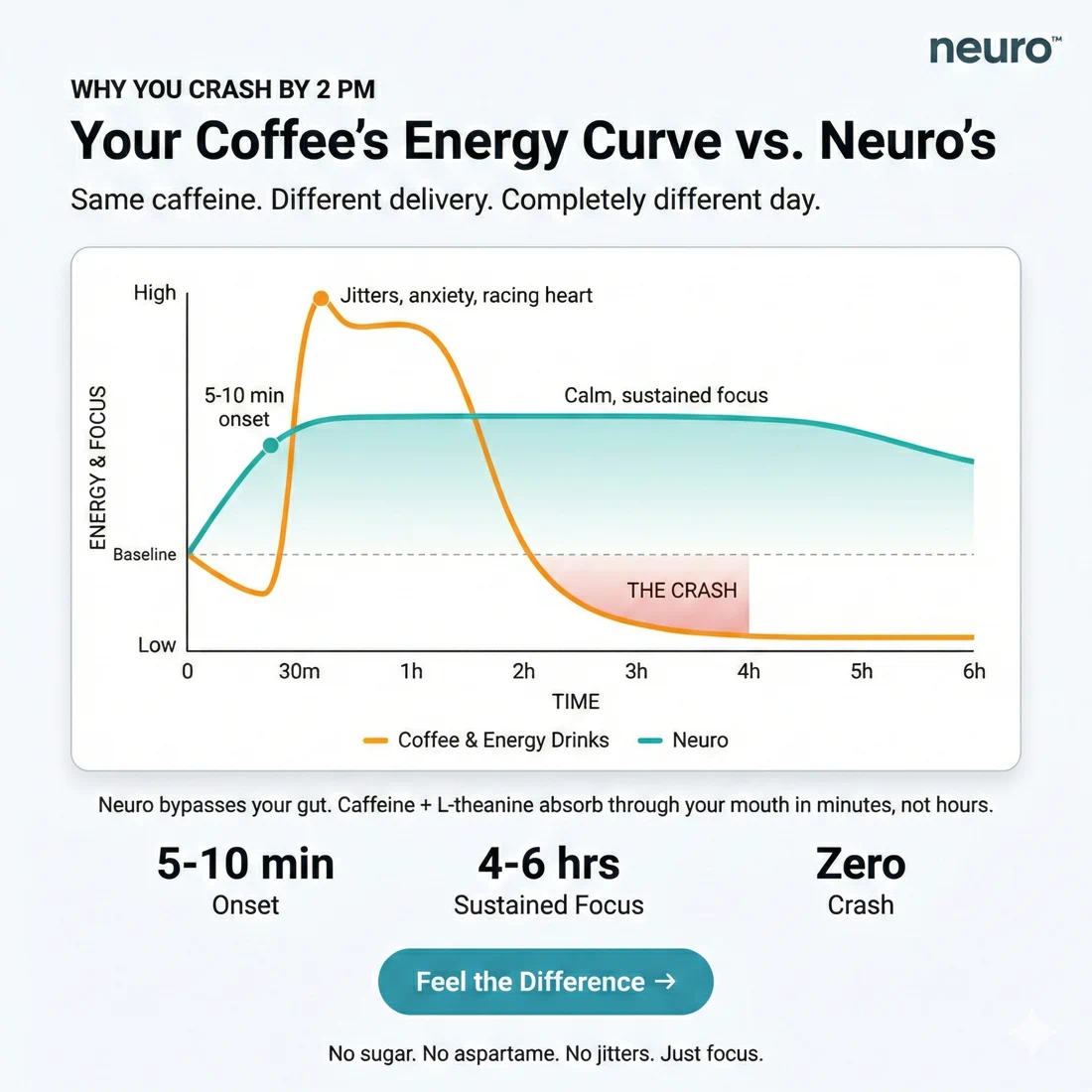
Caffeine is not the villain, caffeine alone is. For centuries, monks drank caffeinated tea and stayed calm, clear, and locked in through long hours of meditation, and their secret was never superhuman discipline, it was a pairing: tea also contains L-theanine, an amino acid that smooths the stress response and turns jittery stimulation into the kind of steady, usable attention you actually want.
Caffeine provides the light. L-theanine provides the lens.

Modern research eventually landed on the sweet spot, roughly 40 mg of caffeine to 60 mg of L-theanine, the exact ratio that gives you alertness without the spike and focus without the crash. Two things kept that ratio frustratingly out of reach, though: most teas are slow and wildly inconsistent, and anything you swallow (coffee, pills, capsules) has to crawl through your digestive system first, which is precisely where the forty-five-minute delay and the gut damage both come from.
So the real question became a simple one: what if you could skip the gut entirely?
What that actually looks like
Instead of making you swallow and wait, it absorbs through the lining of your mouth, what's called buccal absorption, and reaches your bloodstream in about 5 to 10 minutes. No digestion. No acid hit. No forty-five-minute lag while your meeting starts without you.
Every piece is built on that researched ratio: 40 mg of natural caffeine from green coffee beans, 60 mg of L-theanine, plus B6 and B12 to support steady neurotransmitter production.
It's the monk's pairing, engineered for a Tuesday.
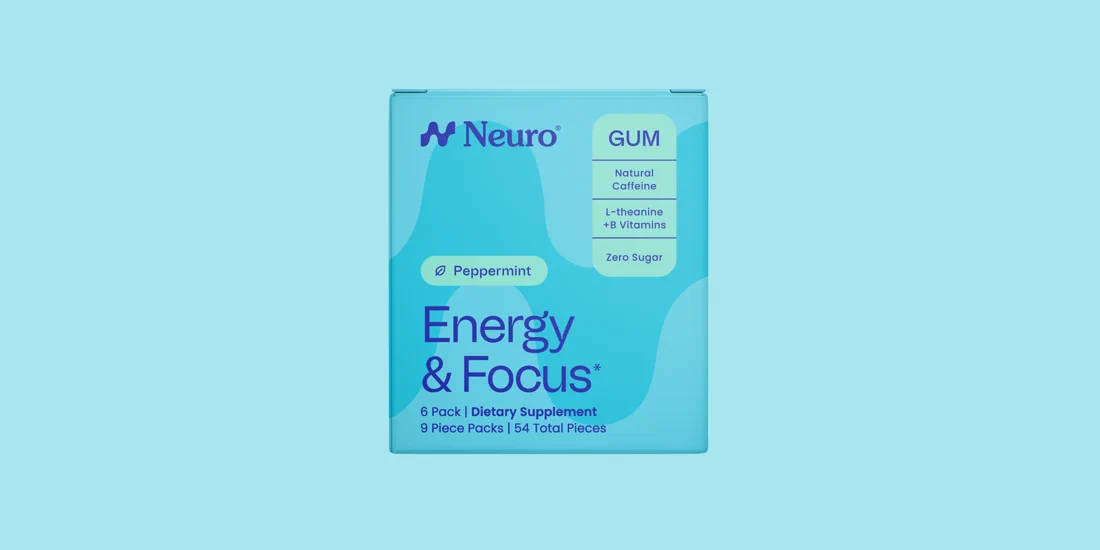
Neuro Energy & Focus gum · 40mg caffeine · 60mg L-theanine · B6 + B12
The caffeine-plus-L-theanine pairing is one of the most studied combinations in cognitive science, and Neuro's own formula has been through a pilot study on attention.
But the loudest proof is the quietest one: the people voting with their mornings.
"Game changer. I use them to get out of bed when I don't have time to make coffee. They help me wake up and don't give me any uncomfortable jitteriness."
Suki, Energy & Focus customer · ✓ verified buyerWhat people sound like once they switch (representative of common reviews)
"I love coffee. I just can't drink it anymore, it destroys my stomach. This is the first thing that gives me the lift without the 11 a.m. regret."
Marcus T., software engineer · representative"I keep a pack in my bag for the 2 p.m. wall. Ten minutes and I'm back, and there's no crash at five."
Priya S., product manager · representative"I used to be the guy who 'couldn't work without his morning fix.' I don't say that anymore."
Devin R., consultant · representative
You don't have to quit coffee on day one. Keep the ritual if you love it. Just keep a pack within reach for the 2 p.m. wall, the surprise meeting, the afternoon you genuinely can't afford to lose.
And you're not gambling. Neuro comes with a 30-day risk-free guarantee. Feel the difference, or you don't pay for it.
Feel the difference by 2 p.m. today →
You've spent years assuming the jitters, the crash, and the 2 p.m. fog were just the cost of getting things done.
They were never the cost of focus. They were the cost of how you were delivering it.
You've been fighting your own biology by mistake. It's time to work with it instead.
P.S. Picture that 9:00 a.m. you again: twitchy, third cup in hand, still stuck on the same spreadsheet. Tomorrow morning could look nothing like that. One piece. Five to ten minutes. Then the actual work.
P.P.S. The only thing you're risking is 30 days. If Neuro doesn't change your afternoons, the guarantee changes your money back. Start with the trial pack and find out on your next bad hour.
Comments (illustrative)
started keeping these in my car for the commute home. used to walk in the door fried and snap at everyone. genuinely calmer now??
ok I was sure this was just expensive gum. tried it before a 9am pitch. felt it in like 8 mins, no shaky hands for once. converted.
@Ravi same, the no-jitters part is the whole thing for me. coffee made me feel insane on presentation days.
does the effect actually last? coffee gives me 90 mins then I'm toast
@Theo for me it's a few solid hours and then it just fades, no cliff. that part sold me.
three weeks in. the 2pm slump was the thing I dreaded most and it's basically gone. wish I'd found this sooner.